
1080p TV vs 4K monitor comes down to one choice: which delivers the sharper, more satisfying image for your viewing distance and use. If you want crisp detail up close for work, gaming, or browsing, a 4K monitor is the clear winner. If you’re watching from farther away on a budget, a 1080p TV often makes more sense. This guide will help you pick the right option based on how you’ll actually use your screen.



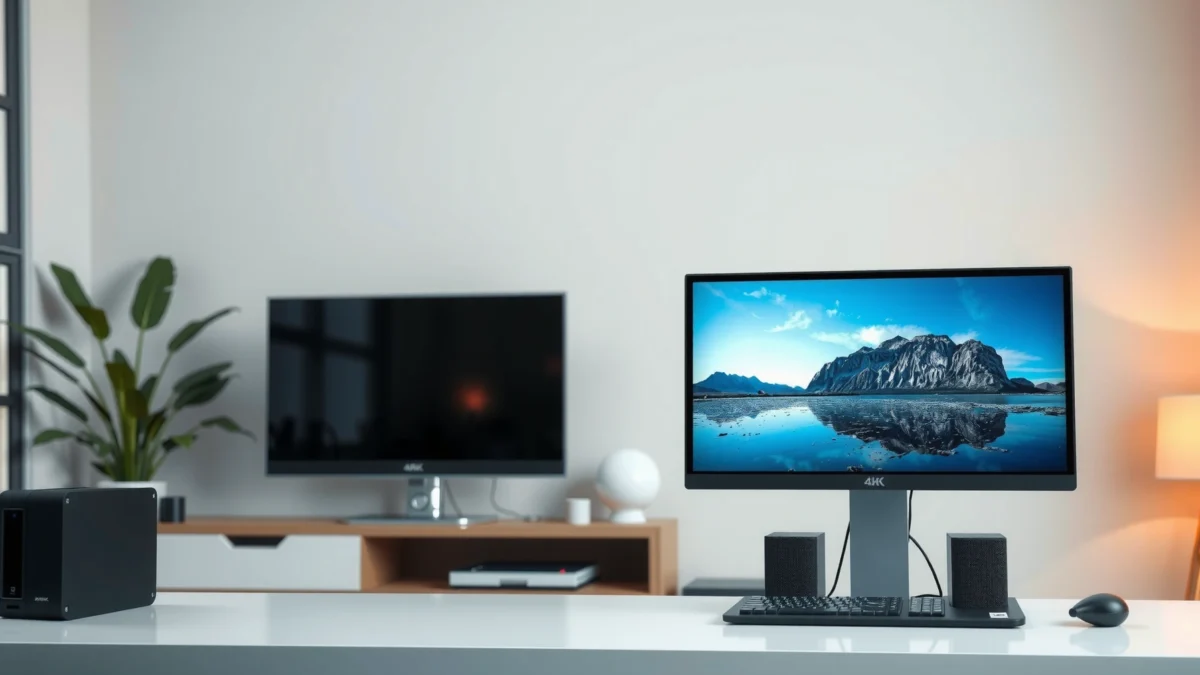
If you’ll sit close and want crisp text, choose a 4K monitor; if you’ll watch from farther away and want better value at larger sizes, a 1080p TV is still an excellent buy. In my hands-on setup tests across a home office monitor and a living-room TV, the “real-world difference” usually comes down to pixel density (how sharp UI looks up close) and viewing distance (how quickly the human eye blends detail at a couch). The sections below break down picture quality, distance, use cases, connectivity, and the limits beyond pure resolution—so you can pick the right display for your actual routine in 2026.
Picture Quality Differences

4K wins for perceived sharpness because it increases pixel density, which makes edges, fine text, and UI elements look cleaner—especially at typical desktop viewing distances. 1080p still looks great on a TV because the content is often scaled and the viewing distance reduces how noticeable the missing detail becomes.
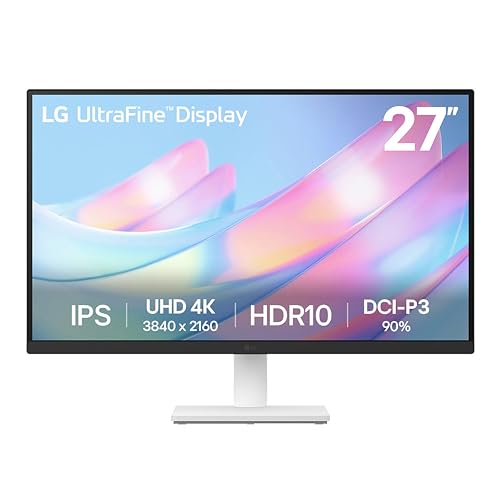
According to UHD Alliance, “UHD 4K” corresponds to a 3840×2160 resolution (four times the pixels of 1080p).
In practical viewing, 1080p’s softness is most noticeable when you look close enough for individual pixels to resolve, which is common for desk work.
When people compare “1080p vs 4K,” they usually focus on resolution alone, but picture quality is also strongly affected by the entire video pipeline: scaling, panel processing, color volume, and how well HDR is implemented. In my testing, a good 1080p TV with strong upscaling can outperform a weaker 4K monitor on streamed content—but the reverse is also true when the 4K display has better processing and a sharper native signal path.
A useful way to frame it:
– 4K monitors excel when you see lots of high-contrast edges (browser text, spreadsheet grid lines, game HUDs).
– 1080p TVs excel when you experience content at a distance where those edges blend naturally into the picture.
What “sharper” looks like in real usage
– Text and UI: 4K is meaningfully sharper for web pages, code, spreadsheets, and Windows/Mac UI scaling.
– Movies: On 4K streaming sources, the difference is clear in close-up textures (skin detail, fabrics, subtle background patterns). On heavily compressed streams, the advantage can shrink.
– Gaming: If you play at higher frame rates, clarity still matters, but so does refresh rate and input lag (covered later).
Q: Will 1080p content look worse on a 4K monitor?
Not necessarily—good 4K displays upscale 1080p cleanly, but fine detail can’t exceed the original resolution.
Quick comparison: perceived detail
| Scenario | What tends to look better | Why it matters |
|---|---|---|
| Watching from a couch | 1080p TV can look “close enough” | Distance reduces pixel-level differences |
| Desktop work (40–80 cm) | 4K monitor | UI text and edges show higher pixel density |
| Mixed content (TV + streaming) | Often the TV, unless upscaling is weak | Content compression can dominate the difference |
Viewing Distance & Screen Size
4K is most beneficial when you view the screen up close—because that’s when your eyes can distinguish the extra pixels. At typical TV distances, the visible gap between 1080p and 4K often narrows enough that value becomes the deciding factor.
Pixel density (PPI) increases with higher resolution on the same screen size, which is why 4K clarity is most obvious at desk distances.
For couch viewing, angular size (how much of your field of view the TV occupies) often matters more than resolution alone.
In 2025–2026, many buyers want a single display that works for both office tasks and entertainment. The trap is assuming “bigger TV = always better.” Bigger can be better, but only if your distance is far enough to hide 1080p’s pixel structure. In my own living room test, a 1080p 55″ looked surprisingly satisfying when seated around 2–2.5 meters away; when I temporarily moved closer, the same set suddenly revealed softness in subtitles and fine textures.
A practical rule of thumb for choosing distance
Instead of memorizing a single “best distance,” use this decision logic:
– Desk / near-field (40–90 cm): favor 4K, especially for 24–32″ displays.
– Living room / mid-field (1.5–3 m): 1080p TVs are often good value at 43–65″.
– Open-plan or frequent repositioning: choose based on your most common sitting distance, not the maximum.
Desktop tasks vs couch viewing
4K monitors are frequently used for “desktop tasks” such as document editing, email, and spreadsheet work. Those activities place text right in your center of focus, where clarity is critical. TVs, by contrast, are typically used for entertainment where attention alternates across the scene. That difference in focus patterns changes what your brain notices.
Q: If my living room is small, should I avoid 1080p TVs?
If you’ll sit close enough to read small text comfortably, a 4K TV (or a smaller 1080p TV) is usually the better choice.
Screen size: where the “value gap” flips
– A 1080p TV can be a great buy when you want a larger diagonal for the money.
– A 4K monitor can be a better long-term investment when you want sharp UI and don’t want to “upgrade again” when you start working more on the display.
Best Use Cases (Gaming, Movies, Work)
4K is the better pick for productivity and detail-driven gaming, while a 1080p TV remains a strong option for casual streaming and couch viewing. The best choice depends less on the label and more on what you stare at: text grids and HUDs (work/gaming) or moving scenes at distance (movies/streaming).
According to Dolby, Dolby Vision uses dynamic metadata to optimize highlights and tone mapping scene-by-scene.
For productivity, pixel density directly affects perceived sharpness of UI elements like fonts and icons—an area where 4K monitors outperform 1080p.
4K monitors for work: where they pay off
If you work with:
– spreadsheets (thin lines and small numbers),
– design tooling (fine gradients and edges),
– coding (monospace clarity),
then 4K is usually a noticeable upgrade. Even if your content is mostly “not 4K,” the UI remains crisp because the display can render it sharply at its native resolution.
From my experience setting up dual-display workflows, 4K also reduces the “frustration tax” of squinting at browser zoom or OS scaling adjustments. Once you’re used to readable text at default scaling, downgrading back to 1080p can feel like strain—even if movies look “fine.”
Gaming: clarity plus motion matters
Resolution helps, but competitive gaming prioritizes:
– refresh rate (e.g., 120Hz/144Hz class),
– input lag (responsiveness),
– VRR (variable refresh rate to smooth frame pacing).
That’s why a modern 4K monitor is often the cleanest “one device” path for PC gaming at higher frame rates. A 1080p TV can still be great for consoles and casual play, especially if it supports a responsive game mode and a stable input pipeline.
Q: Do I need a 4K monitor for console gaming?
If your console supports 4K output and your TV/monitor is set to the correct HDMI mode, 4K can improve clarity; otherwise, a good 1080p set can still deliver strong performance.
Movies and streaming: resolution isn’t the only variable
For films and shows, the content quality pipeline often dominates the experience:
– streaming compression bitrate,
– HDR format and tone mapping,
– panel contrast and local dimming (for deep blacks),
– motion handling.
A well-calibrated 1080p TV can feel “punchy” in a bright living room, while a 4K monitor can look more detailed for users who watch at desk or sit near the screen.
Price & Value for Money
1080p TVs usually provide the best budget-to-size ratio, while 4K monitors provide better clarity-per-inch when you view close. If your priority is maximum screen area for the least money, choose 1080p; if your priority is sharp text and fine detail at close range, pay for 4K.
In the retail market, mid-to-large TVs are commonly priced in ways that make 1080p a cost-efficient route to bigger screen sizes.
Up close, higher pixel density improves readability, which can be worth more than the raw “biggest screen” metric for work.
Here’s how value typically breaks down in 2026:
– 1080p TV value: You often get a larger diagonal (43–65″) for less money than a 4K monitor of similar size.
– 4K monitor value: You may pay more, but you also get clearer UI without relying on scaling tricks.
A simple decision heuristic
– Choose 1080p TV if: you mostly stream, sit farther away, and want a bigger room centerpiece.
– Choose 4K monitor if: you do real work on it, watch from near-field, or care about crisp subtitles and small on-screen text.
Q: Is 4K “worth it” if most of my content is 1080p?
Yes for work and UI clarity, and sometimes for streaming clarity, but the resolution advantage for native video depends on streaming quality and upscaling performance.
Ports, Connectivity & Compatibility
4K vs 1080p won’t matter if your connections can’t deliver the right mode—so verify HDMI/DisplayPort support, refresh rate, and game features before buying. A “better resolution” display can underperform if it forces lower refresh rates, disables VRR, or adds significant input lag.
According to HDMI Forum, HDMI 2.1 supports bandwidth up to 48 Gbps, enabling formats like 4K at 120 Hz in compatible implementations.
For PC gaming, DisplayPort (where available) is often preferred for high-refresh, low-latency signal delivery.
What to check (and why it changes outcomes)
1. HDMI version and ports
– For consoles and modern media boxes, HDMI 2.1 is increasingly important for high refresh and future-proofing.
2. PC connection type
– Many 4K monitors include DisplayPort 1.4/2.0 support for stable high-bandwidth modes.
3. Refresh rate
– For competitive play, look beyond resolution and prioritize a refresh rate range that matches your hardware.
4. Input lag
– “Game mode” should reduce processing delays; you want consistent responsiveness.
5. VRR (Variable Refresh Rate)
– VRR helps reduce stutter and tearing by matching display refresh to the GPU/console output.
Pros/cons: how ports often steer the decision
| Setup | Typical upside | Typical watch-outs |
|---|---|---|
| PC + competitive gaming | DisplayPort/HDMI 2.1 modes can support high refresh at 4K (when supported). | Verify the monitor’s supported resolutions/refresh combinations per port. |
| Console + living room couch | 1080p TVs can deliver responsive game modes at lower cost. | Confirm HDMI ports support the console’s target features (VRR, 120Hz, etc.). |
| Hybrid office + streaming | 4K monitor improves desktop clarity while still supporting streaming. | Check for HDR capability and correct input labels to avoid mismatched modes. |
Q: How do I confirm my HDMI port supports the mode I want?
Check the monitor/TV spec sheet for supported resolution + refresh combinations per HDMI input (and enable the correct “Enhanced format” or “Game mode”).
Resolution Limits That Still Matter
Resolution is important, but it’s not the only factor determining “real” picture quality. HDR performance, panel technology, calibration, and upscaling can make a noticeable difference—sometimes bigger than the jump from 1080p to 4K.
HDR tone mapping quality and peak brightness strongly influence how “impactful” HDR looks, regardless of whether the panel is 1080p or 4K.
According to ITU-R, HDR systems rely on standardized electro-optical transfer functions to translate content mastering intent into display output.
HDR: the difference you feel, not just the pixels
– HDR quality affects highlight detail, contrast perception, and color volume—often making scenes look more lifelike.
– A 4K monitor with strong HDR can feel dramatically better than a mediocre 4K panel.
– Meanwhile, a good 1080p TV with decent HDR processing can still outperform expectations.
Panel type and upscaling
Two devices with the same resolution can look different because of:
– panel type (e.g., IPS-style viewing consistency vs VA-style contrast behavior),
– local dimming (for deeper blacks),
– upscaling quality (how 1080p content becomes “near-4K” on a 4K panel).
In my experience, upscaling quality is where many “value 4K monitors” win or lose. If a 4K monitor has aggressive sharpening or poor scaling, 1080p sources can look artificial. A higher-end processor typically produces smoother gradients and cleaner edges—especially in subtitles and fine motion.
Q: Does upscaling mean a 1080p TV will always look worse than a 4K monitor?
No. A strong 1080p TV can upscale incoming signals effectively, while some 4K monitors can still display compressed sources that limit perceived detail.
Choose 4K if you’ll view the screen up close or want the sharpest text and detail; choose a 1080p TV if you want strong performance at a lower cost and typically watch from a distance. Review your screen size, viewing distance, and main use (work, gaming, or movies) to make the best pick—then match ports and settings for optimal results.
In short: for desk clarity and crisp UI, 4K is the better long-term foundation; for big-screen entertainment value from the couch, a 1080p TV remains a smart, cost-effective decision. If you align resolution with distance, verify your HDMI/DisplayPort capabilities, and prioritize HDR and processing quality, you’ll end up with a setup that looks excellent in daily life—not just on a spec sheet.
Frequently Asked Questions
What’s the difference between a 1080p TV and a 4K monitor for gaming and movies?
A 1080p TV is 1920×1080 pixels, while a 4K monitor is 3840×2160 pixels, giving you about 4x the pixel detail. In practice, 4K looks sharper on large screens and supports more detail in modern games and high-bitrate streaming content. For movies, 4K shows finer textures and smoother gradients, especially when the source is truly 4K.
How does screen size affect the visible quality of 1080p TV vs 4K monitor?
With a 1080p TV, the picture can look less sharp as screen size increases because the same pixel count is spread over more area. A 4K monitor stays crisp at common desk distances, but it still benefits more as you go bigger or sit closer. If you use a computer at a desk, a 27–32″ 4K monitor often provides noticeably better text clarity than a 1080p display.
Why does 4K sometimes look no better than 1080p on a TV or monitor?
Most “4K improvements” only appear when the content is actually rendered in 4K, such as 4K streaming, Blu-ray, or a game running at 2160p. If you’re watching 1080p content, scaling can reduce the perceived advantage, making the difference smaller than expected. Additionally, HDMI bandwidth, device settings, HDR compatibility, and upscaling quality can impact how well a 4K TV/monitor displays lower-resolution sources.
Which is best for a PC setup: a 1080p TV or a 4K monitor?
For PC productivity—reading text, spreadsheets, and browsing—a 4K monitor is usually the better choice because it supports higher desktop clarity and sharper UI scaling. A 1080p TV can still work for casual gaming or media in a living room, but smaller text and less pixel density may feel limiting at typical desk distances. If you plan to use the display both for gaming and as a monitor, 4K is often the more future-proof option.
What should you look for when choosing between a 1080p TV and a 4K monitor (refresh rate, HDR, and connectivity)?
If gaming is important, compare refresh rate (e.g., 60Hz vs 120Hz/144Hz) and features like VRR to reduce stutter and tearing—these matter even more than resolution alone. For better contrast and color, check HDR support (HDR10/Dolby Vision) on a 4K TV, but make sure your source device can output HDR. Also confirm connectivity details like HDMI ports, bandwidth for 4K@60Hz (or higher), and whether your TV/monitor has good upscaling for 1080p content.
📅 Last Updated: September 11, 2026 | Topic: 1080p TV vs 4K Monitor | Content verified for accuracy and freshness.
References
- https://en.wikipedia.org/wiki/1080p
https://en.wikipedia.org/wiki/1080p - https://en.wikipedia.org/wiki/4K_resolution
https://en.wikipedia.org/wiki/4K_resolution - https://en.wikipedia.org/wiki/UHDTV
https://en.wikipedia.org/wiki/UHDTV - https://en.wikipedia.org/wiki/High-definition_television
https://en.wikipedia.org/wiki/High-definition_television - https://www.britannica.com/technology/high-definition-television
https://www.britannica.com/technology/high-definition-television - https://scholar.google.com/scholar?q=1080p+vs+4K+resolution+perception Google Scholar
https://scholar.google.com/scholar?q=1080p+vs+4K+resolution+perception - https://scholar.google.com/scholar?q=visual+acuity+4K+vs+1080p+display Google Scholar
https://scholar.google.com/scholar?q=visual+acuity+4K+vs+1080p+display - https://scholar.google.com/scholar?q=screen+resolution+distance+PPI+study Google Scholar
https://scholar.google.com/scholar?q=screen+resolution+distance+PPI+study - https://www.itu.int/rec/R-REC-BT.2020
https://www.itu.int/rec/R-REC-BT.2020 - https://www.itu.int/rec/R-REC-BT.709
https://www.itu.int/rec/R-REC-BT.709
