

The emergence of open-source AI models is revolutionizing the tech landscape by providing a powerful alternative to the proprietary systems dominated by Big Tech companies. This transition not only democratizes access to advanced artificial intelligence capabilities but also empowers smaller developers and organizations to innovate without facing the substantial financial burdens typically associated with proprietary technologies. As we delve into the world of open-source AI, we will explore how these models are shaking up the industry, their myriad advantages, and the implications for the future of artificial intelligence.
The Rise of Open-Source AI

Open-source AI models are gaining momentum, driven by their accessibility and the collaborative spirit that defines their development. Unlike traditional proprietary models, which often come with hefty licensing fees and restrictive usage agreements, open-source alternatives invite developers and researchers from all backgrounds to experiment, improve, and share their work. This inclusive approach has led to a thriving ecosystem where innovation flourishes, as individuals can readily contribute to enhancements and share best practices.
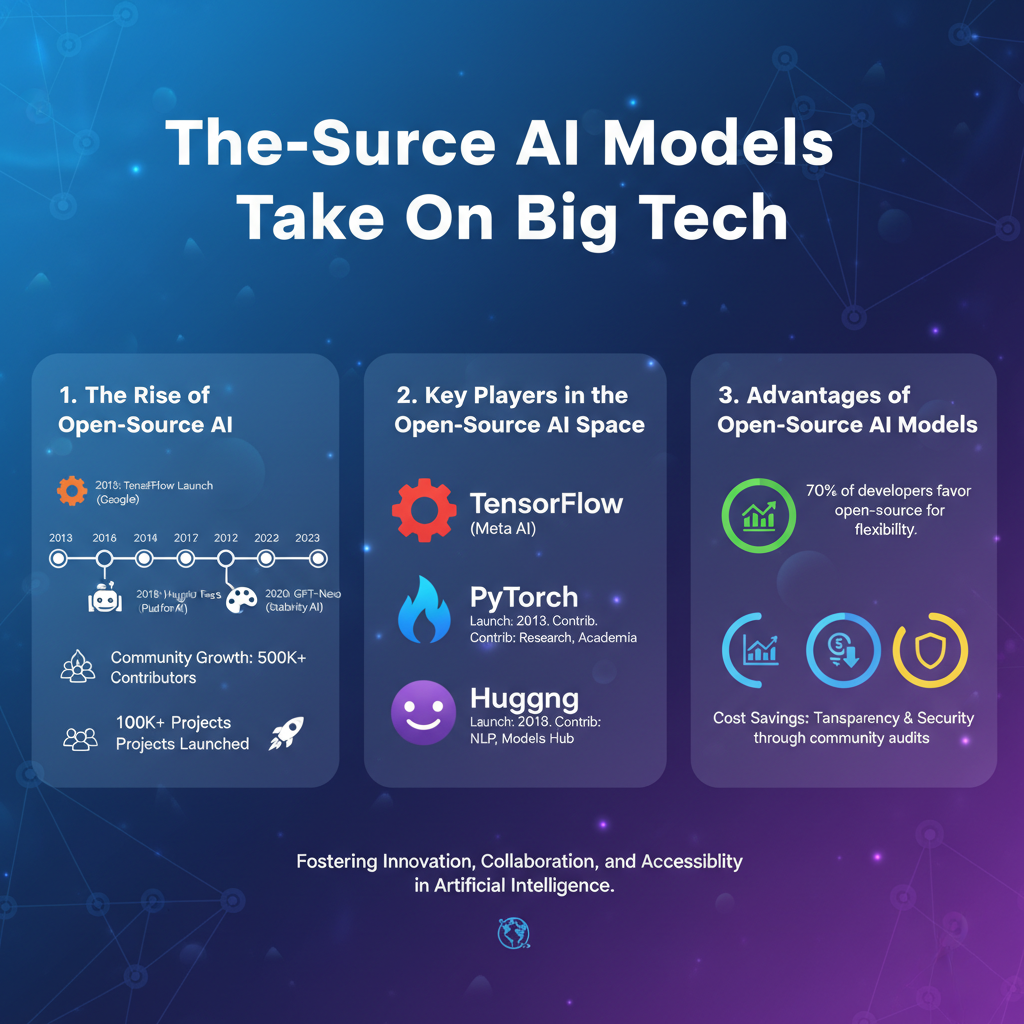
Community-driven development is a hallmark of this rise. For instance, platforms like GitHub host numerous repositories where developers can collaborate on projects like GPT-Neo and Stable Diffusion. These projects benefit from the diverse perspectives and expertise of contributors around the globe, resulting in rapid improvements and the swift identification of bugs or issues. In this environment, creativity and ingenuity are not just encouraged; they are essential for the survival and growth of these models.
Key Players in the Open-Source AI Space

Several notable projects and organizations are spearheading the open-source AI revolution. GPT-Neo, developed by EleutherAI, is a prominent example that aims to replicate and democratize the capabilities of OpenAI’s GPT-3. With a community-driven approach, EleutherAI has made significant strides in making powerful language models accessible to anyone willing to experiment with them. This initiative has inspired many developers to create applications ranging from chatbots to educational tools, showcasing the versatility of open-source models.
Another key player is Hugging Face, which has emerged as a central hub for open-source AI development. The Hugging Face Model Hub hosts thousands of pre-trained models, allowing users to easily access and deploy state-of-the-art algorithms in their projects. Their user-friendly interface and emphasis on community engagement make it a go-to resource for both seasoned AI practitioners and newcomers alike. By lowering the barriers to entry, organizations like Hugging Face and EleutherAI are fostering an environment where innovation thrives.
Advantages of Open-Source AI Models
The benefits of open-source AI models are manifold, making them an attractive option for startups, researchers, and independent developers. One of the most significant advantages is cost-effectiveness. Startups, often operating on tight budgets, can leverage powerful AI tools without the burden of high licensing fees. This financial accessibility enables a broader range of innovators to explore AI applications, leading to a more diverse landscape of ideas and solutions.
Transparency is another critical advantage of open-source AI. With open-source models, algorithms and training data are publicly available, allowing users to scrutinize the systems they are implementing. This transparency fosters trust and accountability, which is particularly important in an age where concerns about bias and ethical considerations in AI are at the forefront. Developers can better understand how a model makes decisions, which not only enhances user trust but also helps identify and mitigate potential biases in the algorithms.
Challenges Faced by Open-Source AI
Despite their many benefits, open-source AI models also face significant challenges. One of the foremost concerns is ensuring data privacy and security. In an open-source environment, anyone can access the code and data, which can complicate efforts to protect sensitive information. Developers must be vigilant about the data they use for training models, ensuring that they adhere to privacy regulations and ethical standards.
Quality control is another area where open-source models can struggle. The variability in contributions from a diverse pool of developers means that the quality of models can fluctuate significantly. While many projects benefit from enthusiastic contributors, others may suffer from incomplete documentation or lack of maintenance. This inconsistency can be frustrating for users who rely on these models for critical applications. As such, ongoing community support and clear guidelines are essential to maintaining high quality.
Impact on Big Tech Companies
The rise of open-source AI models is undoubtedly shaking up the competitive landscape for Big Tech companies. With the emergence of robust open-source alternatives, these companies are now facing increased competition that can drive innovation and lead to more affordable AI solutions. As consumers and businesses become aware of the capabilities offered by open-source models, they may begin to shift their preferences away from proprietary systems, prompting Big Tech to rethink their strategies.
To adapt, Big Tech companies may need to incorporate open-source elements into their offerings. This could involve embracing open-source partnerships or contributing to existing projects, creating a hybrid model that combines the best of both worlds. By collaborating with open-source communities, these companies can tap into a wealth of creativity and innovation while also addressing the growing demand for transparency and ethical considerations in AI development.
The Future of AI Development
Looking ahead, open-source models are poised to play a pivotal role in the democratization of AI technology. As more individuals and organizations recognize the potential of these models, we can expect an increase in collaboration and knowledge-sharing across the tech community. This shift may lead to breakthroughs in areas such as natural language processing, computer vision, and robotics, as diverse perspectives and expertise come together to tackle complex challenges.
Moreover, the collaboration between open-source communities and traditional firms can lead to the development of hybrid models that leverage the strengths of both approaches. By merging the innovation and accessibility of open-source with the resources and infrastructure of established companies, we may see the emergence of more powerful and versatile AI solutions that cater to a broader range of needs.
The emergence of open-source AI models is reshaping the technological landscape by providing alternatives to proprietary systems and fostering innovation. Their accessibility, transparency, and cost-effectiveness are empowering a new wave of developers and researchers, while simultaneously challenging the dominance of Big Tech. As we move forward, staying informed about developments in this space will be crucial, and exploring how open-source AI can be leveraged for various projects may unlock new opportunities for innovation and growth.
Frequently Asked Questions
What are open-source AI models, and how do they challenge big tech companies?
Open-source AI models are publicly accessible artificial intelligence frameworks and algorithms that allow anyone to use, modify, and share the technology. These models challenge big tech companies by democratizing access to advanced AI tools, reducing reliance on proprietary systems, and fostering innovation among smaller developers and organizations. As a result, open-source AI promotes competition and can lead to more diverse applications and solutions in the tech landscape.
How can businesses leverage open-source AI models to compete with big tech?
Businesses can leverage open-source AI models by integrating them into their products and services, which can significantly reduce development costs while enhancing functionality. By utilizing these models, companies can customize AI solutions to meet specific needs, thus improving customer experiences and operational efficiency. Additionally, open-source AI allows smaller firms to innovate rapidly and respond to market challenges without the heavy financial burden typically associated with proprietary technologies.
Why is the rise of open-source AI models significant for data privacy?
The rise of open-source AI models is significant for data privacy because they often provide greater transparency compared to proprietary systems. Open-source projects allow users to inspect the code, understand how data is processed, and ensure that privacy standards are met. This transparency can help build trust among users and organizations concerned about how their data is being used, especially in an era where data breaches and misuse are prevalent.
What are the best open-source AI models to consider in 2023?
Some of the best open-source AI models to consider in 2023 include Hugging Face’s Transformers for natural language processing, TensorFlow for comprehensive machine learning projects, and PyTorch, which is favored for its flexibility and ease of use in deep learning applications. Additionally, OpenAI’s GPT models and Stable Diffusion for image generation are gaining traction. These models not only provide powerful functionalities but also have active communities that contribute to their improvement and support.
Which challenges do open-source AI models face when competing with big tech?
Open-source AI models face several challenges when competing with big tech, including funding and resource limitations, which can hinder their development and support. Additionally, large tech companies often have access to vast amounts of data and computational resources, giving them a significant advantage in training more robust AI systems. Furthermore, the lack of cohesive support and documentation in some open-source projects can make it difficult for users to adopt and implement these technologies effectively.
References
- Open-source artificial intelligence
- https://www.theguardian.com/technology/2023/mar/14/open-source-ai-models-challenge-big-tech
- https://www.bbc.com/news/technology-64972293
- https://www.reuters.com/technology/open-source-ai-challenges-big-tech-2023-02-17/
- https://www.technologyreview.com/2023/01/12/1063468/open-source-ai-toolkit-challenges-big-tech/
- https://www.sciencedirect.com/science/article/pii/S0004370223000051
- https://www.nature.com/articles/d41586-022-04082-0
- Artificial Laboratories | AI Magazine
- https://www.itu.int/en/ITU-T/Academy/Pages/default.aspx