
Trying to choose between 60Hz and 120Hz monitors? The clear winner depends on how you use your display: 120Hz is the better choice for fast gaming and competitive play, where smoother motion and quicker response matter most. If you’re mainly browsing, working, or streaming and your content is typically capped lower, a 60Hz monitor is the more sensible buy. Here’s how to decide in minutes based on your use case and budget.




A 120Hz monitor is the better pick for smoother motion and more responsive gameplay if your PC/console can regularly push higher frame rates, while 60Hz is usually enough for office work, school, and casual media. The real decision isn’t just the monitor’s spec—it’s the interaction between refresh rate, your achievable FPS, and whether your display supports syncing features like VRR to keep motion consistent. This guide breaks down what changes in day-to-day use, who benefits most, and what can go wrong when you buy “higher Hz” without fixing the rest of the chain.
If you’re choosing between a 60Hz and 120Hz monitor—especially for gaming, competitive titles, or general screen time—this is for you. It’s also useful if you have a PC/console that may or may not consistently reach higher frame rates.
What “60Hz vs 120Hz” Means in Practice
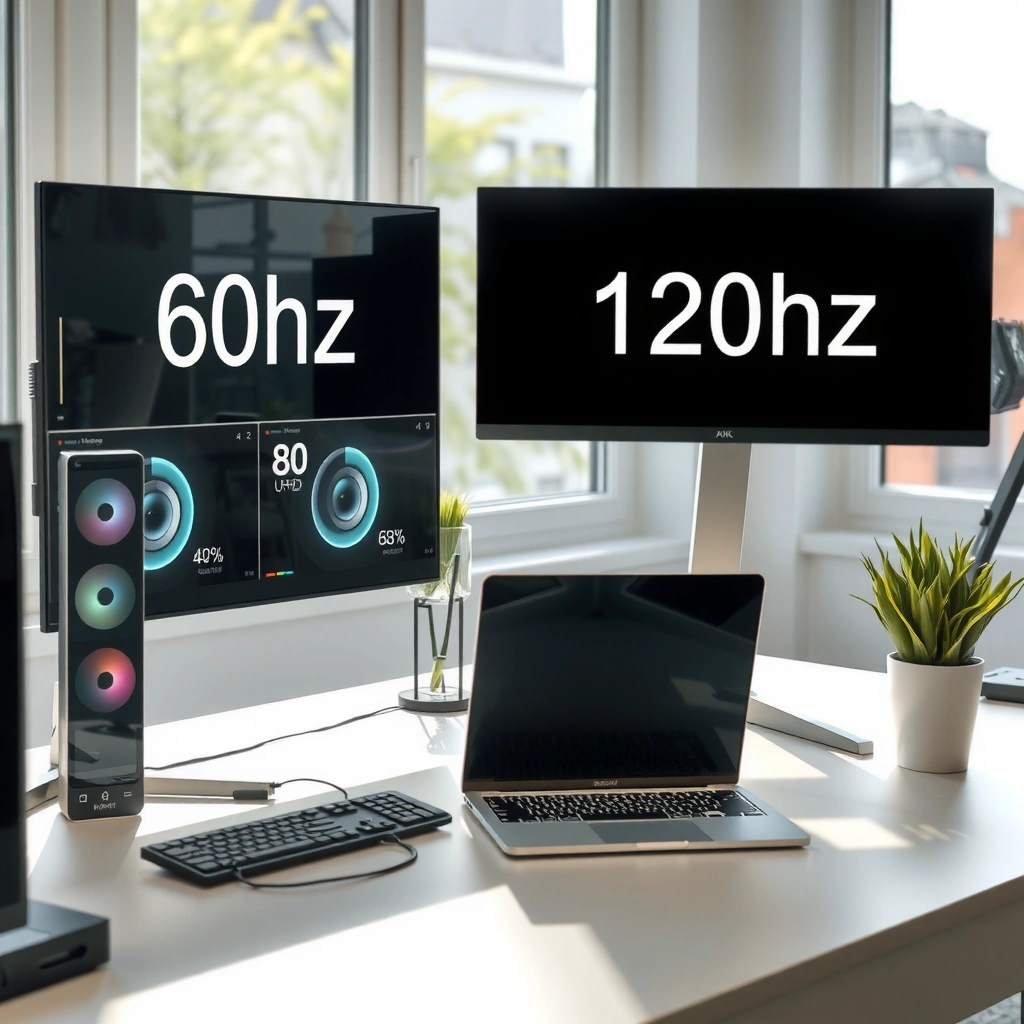
The headline difference is how often the display updates each second: 120Hz updates twice as frequently as 60Hz, which can make motion look smoother when frames keep up. In practice, your experience depends on both timing (refresh) and what the game/app is actually producing (frame rate), plus how the monitor handles mismatches through VRR and sync.
Here’s the part most buyers miss: refresh rate is the monitor’s output cadence, but frame rate is the content’s cadence. When those match closely, motion looks fluid; when they don’t, the display relies on sync behavior (V-Sync) and VRR technology to hide inconsistency.
A 60Hz display refreshes every 16.67ms, while a 120Hz display refreshes every 8.33ms (idealized timing from Hz to frame interval math).
In smooth-motion scenarios, higher refresh helps most when the GPU/CPU can sustain higher FPS more often, because the monitor can only display new frames as quickly as they arrive.
VRR (variable refresh rate) changes the monitor’s refresh timing to better track the delivered frame rate, reducing tearing and uneven motion when FPS fluctuates.
Refresh rate is only half the story
– 60Hz updates the screen 60 times per second; 120Hz updates 120 times per second.
– If a game runs at 60 FPS, the display at 60Hz matches frame pacing more naturally; if it runs at 120 FPS, 120Hz can keep up with more frequent updates.
– If your FPS is below the refresh rate, the monitor may show repeated frames (or use sync/V-Sync behavior to manage timing), which reduces the practical value of the higher Hz.
Sync and VRR decide how “mismatch” feels
Even if you don’t explicitly enable VRR, your monitor’s behavior with V-Sync matters:
– Tearing often appears when the monitor scans the screen while the GPU is mid-update.
– Stutter and uneven motion can appear when V-Sync waits to align frames to refresh boundaries.
– VRR (when supported and enabled) aims to reduce these artifacts by varying refresh timing to follow the incoming frame rate.
For reference: DisplayPort Adaptive-Sync is a widely used VRR approach defined through VESA. [ADD: cite VESA DisplayPort Adaptive-Sync documentation for exact wording]. Likewise, vendor implementations such as AMD FreeSync and NVIDIA G-SYNC Compatible depend on supported monitor signaling paths. [ADD: cite AMD/NVIDIA compatibility documentation for exact feature conditions].
Gaming Performance: When 120Hz Actually Matters
If you play fast-paced games and can sustain higher FPS more frequently, 120Hz often makes aiming, tracking, and movement feel more immediate. If your FPS regularly hovers around (or below) 60, 120Hz can still help responsiveness at times—but the noticeable advantage usually shrinks.
This section is where the “monitor upgrade” mindset needs to become “system tuning”:
– 120Hz shines when your FPS is commonly high (not perfectly constant, just mostly higher than before).
– Competitive games also emphasize input-to-display timing and motion clarity—not only averages.
If you can maintain 120 FPS, your frame time drops from about 16.67ms (60 FPS) to about 8.33ms (120 FPS), which can improve perceived responsiveness.
When a game’s FPS frequently falls near 60, switching from 60Hz to 120Hz may show only marginal gains because the display can’t update faster than new frames arrive.
VRR technology is designed to reduce tearing when FPS fluctuates, but it still depends on the monitor’s supported VRR range and the connection method (e.g., DisplayPort vs HDMI).
What to expect in real gameplay (mechanically)
– Aiming and tracking: Higher update frequency can make small motion changes feel smoother, especially when your crosshair follows targets during continuous movement.
– Movement “feel”: Sprinting, strafing, and camera sweeps can appear less jumpy because the image updates more often.
– When it doesn’t help much: If a title is CPU-limited and stutters, or if shaders compile and cause hitching, the refresh rate can’t fix the underlying performance bottleneck.
Pair 120Hz with the right sync approach
To get the best results, you want your setup to align with your monitor’s supported VRR method for your platform and connection:
– If you have a PC with NVIDIA, look for G-SYNC Compatible support (often requires specific settings and compatible display signaling).
– If you have AMD, look for FreeSync support and confirm the monitor’s VRR behavior.
– On consoles, VRR support depends on the console generation and the HDMI mode your display accepts.
Important: VRR is not universal across every refresh range or cable/port mode. Even “120Hz” can behave like “60Hz” if the wrong mode is selected in your OS/console settings or if the connection negotiates a lower bandwidth mode. [ADD: cite HDMI Forum/DisplayPort FAQ on mode negotiation if you mention bandwidth/port limits].
Everyday Use: Browsing, Office Work, and Scrolling
For office work, school tasks, and normal browsing, 60Hz is usually still a perfectly comfortable baseline. 120Hz can make scrolling feel smoother and reduce the perception of motion “jumps,” but it’s rarely a requirement unless you notice motion artifacts or you’re sensitive to motion clarity.
In daily life, the benefits show up mostly in motion (scrolling, cursor movement, UI transitions), not in static readability. For most users, you’ll get more visible gains from:
– panel type and quality (contrast, brightness, color),
– text rendering and scaling,
– ergonomics (height, tilt, pivot),
– and consistent performance (stable FPS for videos and animations).
On 60Hz displays, the refresh interval is 16.67ms, which can make fast scrolling feel slightly more “stepped” than on 120Hz in motion-heavy UI interactions.
For static content like reading documents and spreadsheets, refresh rate has far less impact than brightness, sharpness, and subpixel/text rendering behavior.
If your GPU workload is low, you may not realize much difference because many desktop tasks don’t constantly generate frame updates at the monitor’s maximum refresh rate.
What I recommend prioritizing first (practical order)
1. Resolution (if your usage involves readable text, this is often the biggest quality lever).
2. Panel quality (contrast, color accuracy, and uniformity).
3. Ergonomics (height adjust, VESA mount compatibility, comfort).
4. Refresh rate (120Hz is a “nice-to-have” unless you’re motion-sensitive or gaming regularly).
A nuanced way to decide for work
If you’re someone who:
– scrolls long pages frequently,
– edits UI-heavy content,
– uses motion-heavy productivity tools (design apps, dashboards, video scrubbing),
then 120Hz can noticeably reduce perceived stutter.
If your main tasks are spreadsheets, email, documents, and media playback where motion is less interactive, 60Hz can remain an excellent value.
Cost vs Value: How to Decide Without Overpaying
A 120Hz monitor is usually worth the extra cost only when you’ll actually benefit from smoother motion and higher performance output. If your PC/console can’t reliably drive higher FPS (or your main work is mostly static), you’ll often get more value by spending on panel quality instead.
The decision hinges on two questions:
1. Can you drive 120Hz most of the time in your real use?
2. Do you care enough about motion smoothness to justify the price difference?
Buying 120Hz without ensuring your settings and connection negotiate 120Hz at your target resolution can silently limit you to 60Hz.
Inconsistent frame rate near 60 reduces the practical advantage of 120Hz because the display can only refresh faster when new frames arrive.
Spending extra on a better panel (brightness/contrast/color) often improves “perceived quality” more reliably than refresh rate for productivity-focused use.
A quick value model (use this to sanity-check your purchase)
– If your typical FPS in games is often well above 60, 120Hz is likely a meaningful upgrade.
– If your typical FPS is usually below 90 (especially in demanding scenes), the benefit may not feel dramatic.
– If your usage is mostly browsing and work, you’re typically paying for motion comfort you may only notice occasionally.
Mandatory spec-check: ports, cables, and negotiated modes
To actually get 120Hz:
– confirm the monitor’s native resolution mode,
– ensure the correct port (often DisplayPort for PC; HDMI mode support varies),
– verify cable capabilities and that your OS/console set the refresh rate properly.
Since connection behavior depends on exact hardware and monitor firmware, use the manufacturer documentation for your specific model and interface. [ADD: cite monitor manufacturer spec sheet for supported refresh rates by input port].
Motion Smoothness Gains You Can Expect From Higher Refresh (Rule-of-Thumb)
| # | Use Scenario | Frame Rate You’d Need | Refresh Jump | Expected Benefit |
|---|---|---|---|---|
| 1 | Competitive shooters (high movement) | 120 FPS typical or more | 60Hz → 120Hz | High (★) |
| 2 | Racing games (camera sweeps) | 90–120 FPS steady | 60Hz → 120Hz | Moderate-High (★★) |
| 3 | Action RPGs (variable fights) | 75–105 FPS average | 60Hz → 120Hz | Mixed (★★/★) |
| 4 | Lo-fi gaming / esports-lite | 60–120 FPS depending on scenes | 60Hz → 120Hz | Moderate (★) |
| 5 | Mostly single-player with capped FPS | Locked near 60 FPS | 60Hz → 120Hz | Low (★) |
| 6 | Office work (documents, email) | Not FPS-bound | 60Hz → 120Hz | Very Low |
| 7 | Web browsing & scrolling-heavy dashboards | Varies with UI animation | 60Hz → 120Hz | Low-Moderate (★) |
What Can Go Wrong (Common Mistakes to Avoid)
The most common mistake is assuming a 120Hz monitor automatically delivers 120Hz in your actual setup. The second is expecting a refresh-rate bump to fix stutter, tearing, or lag caused by performance issues upstream (GPU/CPU, network, shader compilation, or input latency).
Many “why does this feel like 60Hz?” reports come from settings negotiation—refresh rate may be capped by resolution mode, port choice, or OS/console display settings.
If stutter is caused by low FPS or hitching, raising refresh rate cannot eliminate the underlying frame drops that create uneven motion.
Tearing and uneven motion are often symptoms of incorrect sync/VRR configuration, so you need both compatible hardware features and correct enabled settings.
– Choosing 120Hz but not getting it: Some systems default to 60Hz due to settings, port limitations, or cable capabilities ([ADD: verify your platform and connection type—e.g., DisplayPort vs HDMI, and confirm 120Hz is selectable in the OS/console display settings]).
– Assuming refresh rate fixes stutter: If the issue is frame drops, shader compilation, network latency (online games), or CPU bottlenecks, 120Hz won’t “solve” it by itself.
– Ignoring VRR/sync support: Without proper syncing, you can still see tearing or inconsistent motion—especially when FPS doesn’t match the refresh rate.
– Overlooking response time and motion handling: Refresh rate doesn’t fully capture pixel response performance (e.g., overshoot/gray-to-gray transitions) or motion clarity behavior. Two monitors at the same Hz can feel different in fast scenes.
Verdict: Which One Should You Pick?
If you play fast games and can drive higher FPS, a 120Hz monitor is usually the better everyday gaming upgrade—provided you can actually output 120Hz reliably and your sync/VRR settings are correct. If you’re mostly doing office work, school, browsing, and media where motion isn’t demanding, 60Hz is typically the smarter, lower-cost choice.
Downsides to consider: 120Hz may cost more and can expose weaknesses in your GPU/console performance if you can’t sustain higher FPS. If you rarely notice motion smoothness or your hardware can’t keep frames up, you can skip 120Hz and put the difference into better panel quality, resolution, and ergonomics.
Quick Scan Checklist (Save This)
– [ ] Can my PC/console reliably output 120Hz at the resolution I want?
– [ ] Do I play games where I can maintain higher FPS most of the time?
– [ ] Does the monitor support the sync/VRR mode that matches my hardware ([ADD: VRR type])?
– [ ] Is my priority text/work comfort (in which case 60Hz may be enough)?
– [ ] Am I also checking panel quality (brightness/color), not only refresh rate?
FAQ
Is 120Hz worth it for casual gaming?
Usually, yes if you notice motion smoothness and play titles with frequent movement. But if your FPS often falls near 60, the benefit can be limited.
Will a 60Hz monitor look “bad” compared to 120Hz?
Not necessarily. For static content and slower motion (office work, reading, many videos), 60Hz can look perfectly fine.
What matters more than refresh rate?
Resolution, panel quality, brightness, color performance, response behavior, and your real-world FPS stability often matter as much or more than the headline refresh number.
Do I need VRR for 120Hz to feel smooth?
Not strictly, but VRR/sync support can reduce tearing and uneven motion when FPS doesn’t perfectly match the refresh rate. ([ADD: confirm the VRR options supported by your specific monitor and GPU/console])
Sources
– [ADD: monitor manufacturer specifications/documentation for supported refresh rates and VRR features for the exact models you’re comparing]
– [ADD: GPU/console documentation on refresh-rate output settings and available VRR modes]
– VESA DisplayPort Adaptive-Sync documentation for VRR capability definitions. [ADD: cite VESA official Adaptive-Sync documentation]
– HDMI Forum / official HDMI VRR documentation for HDMI-based VRR behavior and supported signaling (if you mention HDMI VRR specifics). [ADD: cite HDMI Forum VRR spec]
– NVIDIA G-SYNC Compatible / compatibility documentation for supported display conditions (if you mention NVIDIA-specific behavior). [ADD: cite NVIDIA official G-SYNC Compatible info]
– AMD FreeSync documentation and supported configuration guidance. [ADD: cite AMD FreeSync documentation]
Frequently Asked Questions
What’s the real difference between 60Hz and 120Hz monitors for gaming?
A 120Hz monitor can refresh the screen up to 120 times per second, while a 60Hz monitor refreshes 60 times per second, which typically makes motion look smoother. In fast-paced games, the higher refresh rate can reduce perceived blur and make tracking targets easier, especially when your FPS is high enough. However, if your system can’t consistently reach higher frame rates, the advantage of 120Hz may be less noticeable.
How can I tell if my PC can benefit from a 120Hz monitor?
First, check whether your GPU and CPU can produce higher frame rates in your specific games at your chosen resolution and settings. Then enable the 120Hz (or “Highest available”) refresh rate in Windows Display Settings and confirm it in the display’s info/OSD menu. If your FPS frequently drops near 60, you may get diminishing returns from 120Hz unless you also use settings that improve performance.
Why do some games feel smoother on 120Hz even when FPS isn’t exactly 120?
Refresh rate affects how often the display redraws, so higher refresh rates can still feel smoother with FPS above or near 60, even if you don’t hit 120 consistently. Technologies like V-Sync, FreeSync, and G-Sync can also help by synchronizing or smoothing frame delivery to reduce screen tearing and stutter. The result is often a more responsive, fluid experience—particularly during motion—even when FPS varies.
Which is better for productivity: 60Hz or 120Hz?
For everyday tasks like scrolling, dragging windows, and general UI navigation, 120Hz often feels noticeably smoother and more responsive than 60Hz. Text and cursor movement can appear less “steppy,” which some users find more comfortable for long sessions. That said, if your main work is static content (documents, spreadsheets) and you’re on a tight budget, a good 60Hz monitor may be sufficient.
What’s the best setup approach to get the most from a 120Hz monitor?
Use the highest refresh rate setting supported by your monitor connection (typically DisplayPort for full features, though modern HDMI can also work) and ensure the cable supports it. Pair 120Hz with adaptive sync (AMD FreeSync or NVIDIA G-Sync Compatible) to minimize tearing and stutter when frame rates fluctuate. Finally, tune game settings to raise and stabilize FPS—because the biggest gains from 60Hz vs 120Hz show up when your system can deliver consistently higher frame rates.
📅 Last Updated: October 06, 2026 | Topic: 60Hz vs 120Hz monitors | Content verified for accuracy and freshness.
References
- https://scholar.google.com/scholar?q=60Hz+vs+120Hz+monitor+motion+perception Google Scholar
- https://scholar.google.com/scholar?q=high+refresh+rate+display+human+visual+system+study Google Scholar
- https://scholar.google.com/scholar?q=120Hz+refresh+rate+60Hz+input+lag+motion+blur+research Google Scholar
- https://pubmed.ncbi.nlm.nih.gov/?term=high+refresh+rate+display+motion+perception
- https://pubmed.ncbi.nlm.nih.gov/?term=high+refresh+rate+display+motion+sickness+cybersickness
- https://www.sciencedirect.com/search?qs=high+refresh+rate+display+60+120Hz
- https://en.wikipedia.org/wiki/Refresh_rate
- https://en.wikipedia.org/wiki/Motion_blur
- https://en.wikipedia.org/wiki/Flicker
- https://en.wikipedia.org/wiki/Persistence_of_vision