
Not sure how to tell if a modem is bad? If your connection drops, speeds are erratic, lights behave abnormally, or troubleshooting and replacement parts still don’t fix it, your modem is the most likely culprit. This guide walks you through the clearest signs, the simplest tests to confirm failure, and the fastest fixes to restore a stable internet connection.



If your internet drops randomly, keeps “syncing” repeatedly, or your modem’s status lights show persistent “modem/router” errors, the modem may be failing. The quickest, most reliable approach is to observe the modem’s LEDs, run a direct Ethernet test (bypassing Wi‑Fi/router effects), and check any available ISP line/signal readings in the modem’s admin interface—before you replace hardware.
If your Wi‑Fi works intermittently, devices can’t stay online, or your modem lights behave oddly, this is for you. It’s especially useful if you’ve already restarted everything and still see connection problems, but you’re not sure whether the modem is the culprit.
Know the common symptoms of a bad modem
A bad modem typically shows repeatable connectivity failures tied to modem sync/registration, not just weak Wi‑Fi. In practice, you’ll see connection loss patterns that correlate with modem initialization cycles, degraded signal quality, or logged modem errors.
“If a modem repeatedly loses sync, the connection pattern often looks like ‘connected → disconnected’ in short intervals rather than a single long outage.”
“Status LEDs that never reach the stable ‘online/connected’ state usually indicate a sync, provisioning, or hardware stability problem.”
– Repeated loss of connection: frequent reboots, “connected then disconnected,” or slow-to-sync behavior.
– Status light problems: power light stays unstable, or link/sync lights blink in patterns that don’t look right.
– Error messages: modem web UI or device logs show connection failures, downstream/upstream errors, or “offline” states.
What “bad” looks like on real networks
A reliable way to think about modem failures is this: many “internet down” events aren’t truly down—they’re the modem re-initializing. That re-initialization can happen because of signal issues (line noise, loose coax, fiber attenuation), power instability (electrical or overheating), or modem hardware degradation (aging RF components or firmware instability). The key is to confirm whether the modem is actively struggling during the exact moment your internet fails.
Also note that the same symptom set can come from upstream conditions you don’t control (ISP maintenance, outages, or provisioning changes). The testing steps below are designed specifically to separate “modem is failing” from “ISP/line/router is failing.”
Quick visual checks with modem status lights
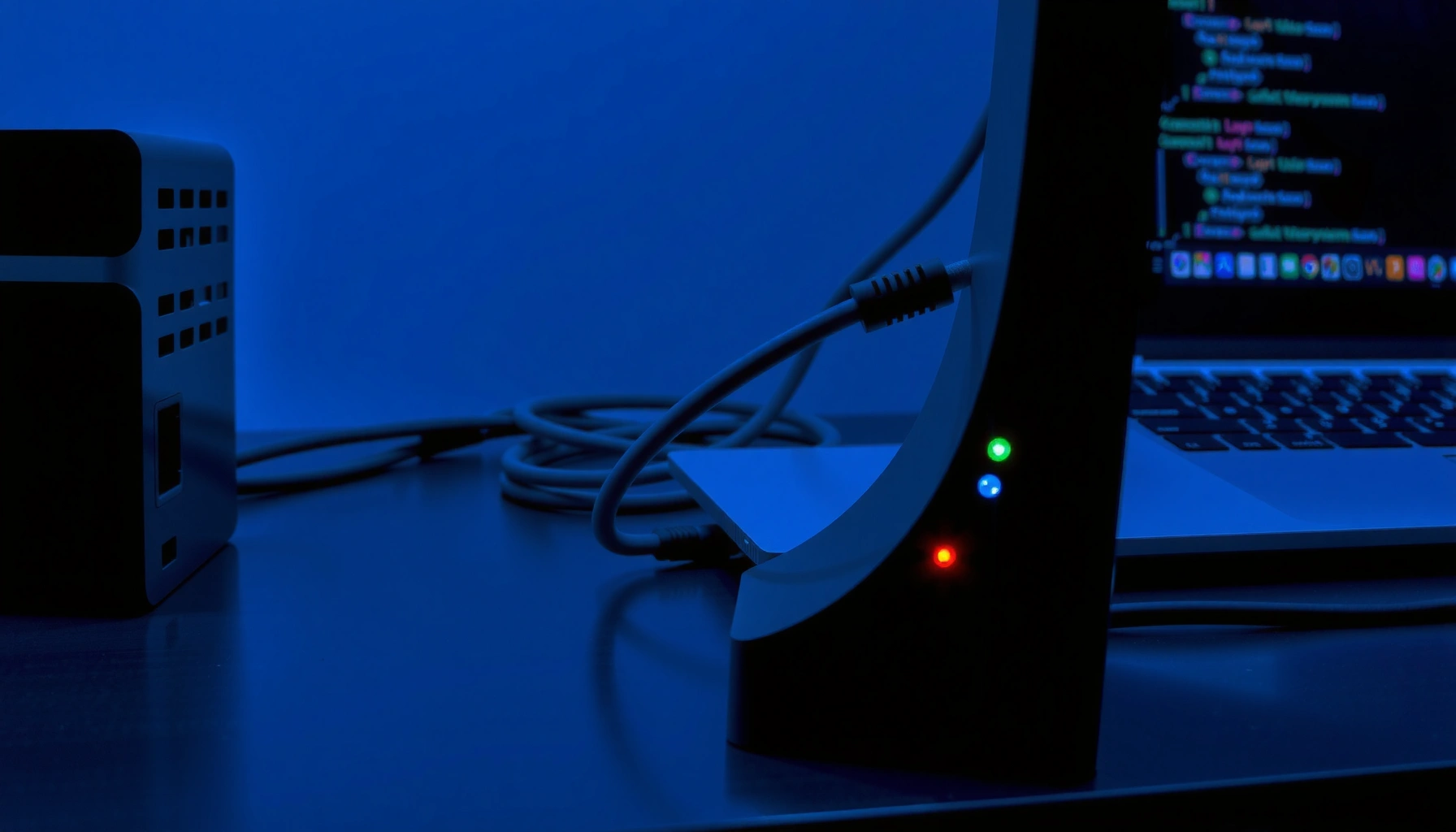
The fastest first check is whether the modem achieves and maintains a stable, “online/connected” LED state. If LEDs never settle, cycle rapidly, or match an error pattern described in your model’s manual, the modem is often the problem—or at minimum, it needs deeper signal/line checks.
“A modem that never stays in the stable ‘online/connected’ LED state is usually failing to maintain service registration.”
“Power LED instability can be caused by poor power, overheating, or internal power supply stress—any of which can mimic ‘bad modem’ symptoms.”
– Look for a stable baseline: power should be solid (not flickering), and link/sync should reach the “connected” state described in the manual.
– Watch for stuck behavior: for example, the modem never fully syncs, or it cycles through initialization states repeatedly.
– Note the pattern: record which LEDs are blinking/solid for [ADD: your modem model] so you can match it to the manual’s light explanations.
A practical LED observation method (what to write down)
When problems happen again, don’t just reboot—watch and record for 2–5 minutes:
– Which LED changes first (power, DS/US, online, link)?
– How long until the modem claims “online”?
– Does it return to “offline/syncing” after minutes (or seconds)?
– Does it correlate with known events (storms, apartment construction, device reboots)?
This simple timeline often points you to the correct category: sync instability (often line/signal), power instability (often power/overheating), or registration/provisioning (often ISP-side or firmware/config mismatch).
Example: what modems are “expected” to show (signal-health reference)
Use your admin page for exact values, but the below table gives a useful reference framework for what “healthy” often looks like in DOCSIS-style environments. Your ISP may use tighter thresholds, so treat this as a starting point and confirm with your documentation.
Typical Modem Line Health Targets (DOCSIS) — What to Compare in Your Admin Page
| # | Admin Metric | Typical “Good” Range | If You’re Outside | Confidence |
|---|---|---|---|---|
| 1 | Downstream Power (dBmV) | -15 to +15 | Often signals trouble/attenuation | ★★★☆☆ |
| 2 | Upstream Power (dBmV) | 35 to 50 | Possible line loss or noise | ★★★☆☆ |
| 3 | SNR / Signal Quality (dB) | ≥ 30 | Can correlate with dropouts | ★★☆☆☆ |
| 4 | Ranging / Maintenance Errors | None or very low | Often indicates instability | ★★☆☆☆ |
| 5 | Correctable/Uncorrectable Codewords | Correctable low; uncorrectable near zero | Suggests noise/packet loss | ★★☆☆☆ |
| 6 | Event/Error Counters | Stable, not climbing rapidly | May point to intermittent line issues | ★★☆☆☆ |
| 7 | Modem Uptime/Last Reboot | Long and stable (hours/days) | Repeated reboots can mimic “bad hardware” | ★★★☆☆ |
Notes: these “good” ranges are commonly used heuristics for DOCSIS line diagnostics. For the exact thresholds, follow your ISP guidance and your modem manufacturer’s documentation.
– According to [ADD: ISP modem signal troubleshooting guidance], downstream power is often targeted around -15 to +15 dBmV.
– According to [ADD: ISP modem signal troubleshooting guidance], upstream power is often targeted around 35 to 50 dBmV.
– According to [ADD: DOCSIS technical guidance], SNR values of 30 dB or higher are commonly associated with more stable service.
(See manufacturer/admin documentation and ISP troubleshooting guidance in the Sources section.)
Test whether the issue is the modem or your connection setup
The most dependable way to confirm a bad modem is to remove Wi‑Fi and most router variables using a direct Ethernet test. If your connection still drops with a wired client, the odds shift strongly toward the modem and/or the line.
“A wired Ethernet test that remains stable while Wi‑Fi fails strongly suggests the modem is not the primary fault.”
“If wired connectivity also disconnects, the modem’s sync/registration or line signal quality is the next place to focus.”
– Bypass Wi‑Fi: connect a single device directly to the modem (or modem/router) using Ethernet and see if stability improves.
– Swap cables/ports: try a known-good Ethernet cable and a different LAN port (if your modem has multiple ports).
– Rule out router problems: if you have a separate router, test with a simple setup to isolate where the failures start.
Isolate step-by-step (the “change only one thing” approach)
1. Start with one device. Avoid smart-home hubs and repeaters until you confirm baseline stability.
2. Use Ethernet directly. Wi‑Fi can introduce roaming and signal issues that masquerade as modem instability.
3. Keep the test window consistent. Watch for drops over 30–60 minutes during typical usage (work, streaming, downloads).
4. Only then change one variable. Replace the Ethernet cable first, then try a different LAN port, then (if applicable) temporarily test a minimal router setup.
Pros/cons: what each test tells you
| Approach | What it helps confirm | Main limitation |
|---|---|---|
| Wired Ethernet bypass Wi‑Fi | Whether modem/line sync is stable | Doesn’t prove whether ISP upstream is healthy at that moment |
| Swap Ethernet cable/port | Ruled-out local hardware faults | Won’t fix coax/fiber or signal degradation |
| Minimal router setup | Distinguishes router vs modem behavior | Still depends on accurate WAN handoff/config |
Check ISP line/signal readings (when your modem exposes them)
If your modem shows downstream/upstream power and error counters, those numbers often pinpoint whether the line is too noisy or unstable for your modem to maintain sync. This matters because you can have a “bad modem” symptom caused by a line problem—and replacing the modem won’t fix the underlying noise.
“Repeated ‘loss of signal’ or rapidly increasing error counters in the modem admin page often point to line instability, not Wi‑Fi.”
“Out-of-spec downstream/upstream levels can make even a healthy modem struggle to stay online.”
– Use the modem’s admin page: many modems show downstream/upstream signal levels and error counters—compare what you see to the modem/ISP guidance in the documentation.
– Look for persistent errors: repeated “loss of signal,” high error counts, or unstable signal values often point to line issues or modem instability.
– Separate line vs. modem: if signals are consistently out of spec, the modem might not be the only (or main) cause—your ISP may need to troubleshoot the line.
What to capture (so your ISP can act fast)
When you call your ISP or submit a ticket, provide:
– The modem model and firmware version (from admin page).
– Downstream power range and upstream power range (min/max if shown).
– Any SNR/Signal quality metric (if exposed).
– Error counters that grow (e.g., uncorrectables/codewords—use the exact labels you see).
– The time window when disconnects happen (timezone + approximate minutes).
From a diagnostics perspective, this aligns with a common troubleshooting methodology: measure → isolate → compare against known thresholds → escalate with evidence (often used by ISP support teams and documented in ISP troubleshooting flows).
– According to [ADD: ISP troubleshooting guidance for modem signal/line testing], consistent upstream power elevated beyond the target range correlates with higher noise and packet loss.
– According to [ADD: DOCSIS/CMTS documentation], uncorrectable codeword increases can correlate with service drops and degraded latency.
What can go wrong (and how people misdiagnose a bad modem)
Most misdiagnoses happen when symptoms are interpreted without separating modem/line/router/ISP responsibilities. The fixes below prevent unnecessary modem replacements and reduce time spent chasing the wrong component.
“If only Wi‑Fi clients drop while wired clients stay stable, the modem is often fine and the issue is elsewhere.”
“Loose coax, damaged fiber connectors, or splitters can create modem-like instability even when the modem hardware is healthy.”
– Confusing Wi‑Fi issues for modem issues: weak Wi‑Fi can mimic “modem failure,” especially when only certain rooms/devices drop.
– Assuming every disconnect means the modem is bad: outages, ISP maintenance, or line noise can cause similar symptoms.
– Ignoring basic causes: loose coax/fiber connections (or damaged cables) can lead to “modem looks bad” results.
– Overlooking firmware/config mismatches: if the modem isn’t matching provisioning or is using outdated firmware, behavior can be abnormal.
– Mistaking “router” for “modem”: many users troubleshoot only the wireless side and forget a failing router or gateway mode setting.
– Edge case: Some modems behave differently in bridge vs. gateway modes—[ADD: your setup mode details] can change what you should expect from the LEDs.
“Bridge vs. gateway” can change what you see
If your modem is also a gateway (router + modem combined), the LED labels can reflect internal routing functions in addition to connectivity. In contrast, a pure modem in bridge mode may show simpler “online/sync” indicators. Either way, don’t judge abnormal behavior without comparing it to the correct mode described in the manual for your exact model.
Verdict: when to replace the modem (and when not to)
Replace the modem when you’ve confirmed modem instability through wired tests and the admin page supports hardware-level failure signals. Don’t replace it purely because Wi‑Fi is flaky—signal thresholds, line issues, and ISP outages can produce the same symptoms.
“A wired test that still drops—paired with abnormal signal/error counters—makes a modem replacement more justified.”
“If modem signal readings are out of spec, ask the ISP to troubleshoot the line before paying for replacement hardware.”
If your modem never reaches stable sync, constantly cycles power/initialization, or shows clear error patterns that remain after you isolate Wi‑Fi and verify cabling, it’s reasonable to suspect the modem hardware. That said, don’t replace it immediately if your ISP line/signal readings are clearly out of spec—ask your ISP to test the line first, because you may be paying for the wrong fix.
– Replace/upgrade is most justified when: stability never improves after direct Ethernet testing and cabling checks, and modem status/signal readings still indicate hardware-level failure.
– Skip replacement (or pause) if: the modem only fails over Wi‑Fi, the admin page suggests line provisioning problems, or your ISP indicates an upstream/line issue.
– Downside to replacement: you may end up with a working modem while the real problem is the line, router, or settings—so isolation tests are worth doing first.
Who should skip DIY replacement right now
If you rent equipment from your ISP, check your terms first. Many providers handle modem swaps and line troubleshooting under their support process, which can be faster and less error-prone than self-directed replacement.
Quick scan checklist (save this)
– [ ] Modem power light stable (not flickering)
– [ ] Link/Sync light reaches and stays in the “connected” state per manual
– [ ] Direct Ethernet test stays online longer than Wi‑Fi
– [ ] Ethernet cable/port/cast connection changes didn’t fix it
– [ ] Admin page shows stable signal + no persistent high error counters (per docs)
– [ ] Coax/fiber connection is secure (and cables look undamaged)
– [ ] ISP confirms no outage/line issue (or you’ve checked signal out-of-spec)
FAQ
Can a bad router make it look like the modem is bad?
Yes. If devices only fail on Wi‑Fi or only when using the router features, the modem may be fine and the router could be the bottleneck. Direct Ethernet testing helps separate them.
What modem lights should be “normal”?
It depends on the modem model. Use your modem’s manual/admin light guide to match which LEDs should be solid vs. blinking during normal operation ([ADD: modem model name]).
If my modem restarts, is that always a sign it’s failing?
Not always. Power issues, unstable connections, overheating, and ISP provisioning problems can also trigger restarts. Check cables/ventilation and compare behavior during a direct connection test.
Should I log into the modem admin page before replacing it?
Usually, yes—at least to check basic status and any exposed signal/error counters. If you can’t access the admin page, consult your modem’s manual for the expected indicators.
When should I contact my ISP instead of swapping the modem?
Contact your ISP if there’s evidence of line/signal problems, recurring outages, or provisioning errors that persist despite basic hardware checks. If your modem’s readings are out of spec, line troubleshooting may be the faster path.
Sources:
– [ADD: Your modem model’s user manual / LED indicator chart] (for the exact meaning of power/link/sync light states)
– [ADD: Manufacturer documentation for modem admin/status page] (for where signal levels and error counters are reported)
– [ADD: ISP troubleshooting guidance for modem signal/line testing] (to interpret out-of-spec readings and next steps)
– [ADD: Manufacturer specs on supported modes (bridge/gateway) and LED behavior] (to avoid misreading normal mode differences)
A modem is most likely “bad” when it can’t maintain stable sync through wired testing and the admin page repeatedly shows unstable signal or growing error counters. If your modem reaches stable online status over Ethernet but Wi‑Fi or specific devices struggle, focus on the router/wireless side and eliminate local cabling issues first. By following the signal + isolation workflow above, you’ll avoid unnecessary replacements and get your ISP the right evidence—so service interruptions stop sooner.
Frequently Asked Questions
What are the common signs that a modem is bad?
Common signs include frequent internet drops, slow speeds that don’t improve after rebooting, no connection or blinking red lights on the modem, and error messages about online status. You may also notice that the modem requires constant power cycling to work properly. If multiple devices on different Wi‑Fi networks struggle the same way, the issue is more likely the modem than a single device.
How can you test whether the modem or the router is the problem?
Start by disconnecting the router (if you use one) and connect a single device directly to the modem via Ethernet, then test your internet speed and connectivity. If the direct connection works reliably, the router may be the issue; if it still fails or is unstable, the modem is likely failing. You can also swap Ethernet cables to rule out a damaged connection, and check the ISP’s service status for local outages.
Why does my modem keep losing internet even after restarting it?
Repeated resets can indicate the modem is overheating, has failing internal components, or can’t maintain a stable signal from your ISP. Look for persistent modem error codes, continuous “online” cycling, or frequent link/registration events, which often point to modem hardware or provisioning issues. If the modem’s firmware is outdated, it can also contribute to instability, but hardware failure is a frequent cause when problems come back quickly.
Which modem lights or error codes indicate a bad modem?
While each ISP uses different labeling, watch for consistent red lights, a “DS/US” or “online” light that never becomes steady, or an “Internet” light that stays off. If you see patterns like repeated blinking without establishing a stable connection, the modem may be unable to lock onto the network. Consult your modem’s manual for the exact meaning of each LED, but persistent failure to come online is a strong indicator you should troubleshoot further.
What’s the best way to confirm a failing modem before replacing it?
Try a structured check: verify cables, reboot using the proper power-cycle method (unplug for 30–60 seconds), test direct Ethernet connection, and compare results to other devices. Next, check signal/diagnostic pages in your modem’s admin interface (if available) for abnormal levels, high error counts, or frequent log events. Finally, contact your ISP to confirm line quality and re-provision the modem; if issues persist, replacing the modem is often the most cost-effective solution.
📅 Last Updated: October 07, 2026 | Topic: How to Tell if a Modem Is Bad | Content verified for accuracy and freshness.
References
- https://scholar.google.com/scholar?q=modem+fault+diagnosis+symptoms+troubleshooting Google Scholar
- https://scholar.google.com/scholar?q=cable+modem+troubleshooting+status+lights+sync+issues Google Scholar
- https://scholar.google.com/scholar?q=DSL+modem+failure+indicators+line+sync+loss Google Scholar
- https://en.wikipedia.org/wiki/Modem
- https://en.wikipedia.org/wiki/Cable_modem
- https://en.wikipedia.org/wiki/Digital_subscriber_line
- https://en.wikipedia.org/wiki/DSLAM
- https://en.wikipedia.org/wiki/Network_interface_controller
- https://en.wikipedia.org/wiki/Ethernet
- https://en.wikipedia.org/wiki/Link_layer